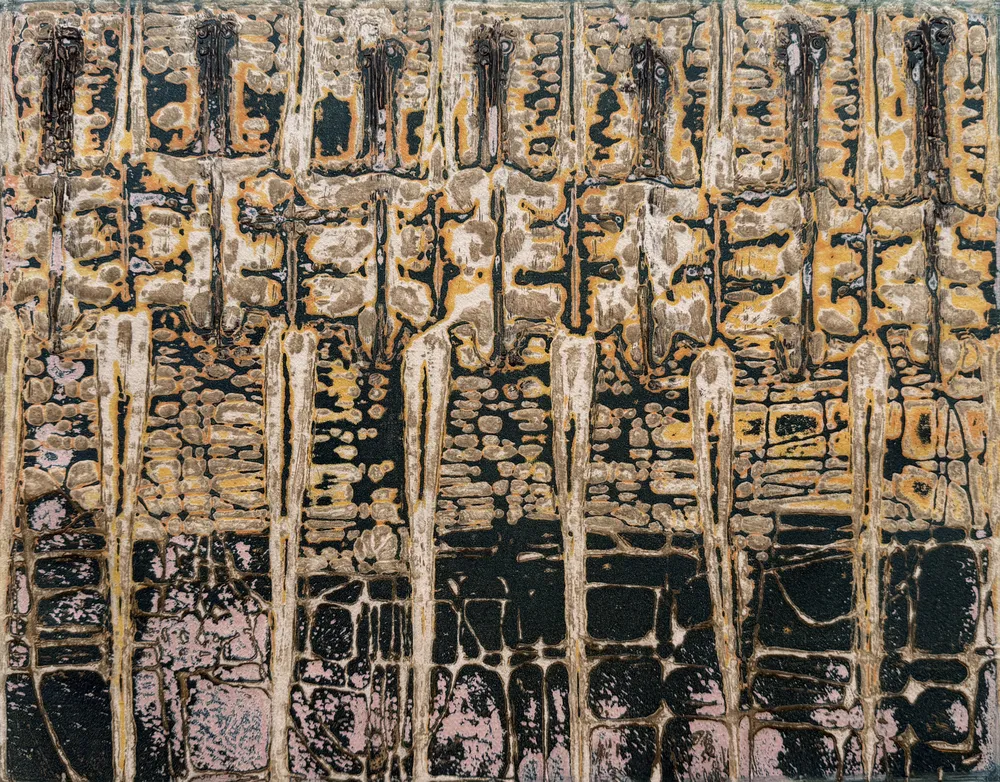
Dolan/Maxwell is pleased to present “United States of Viscosity” at the 2026 IFPDA Print Fair.
Krishna Reddy and Kaiko Moti played a decisive role in the evolution of color printing. Atelier 17 in Paris during the mid-1950s provided an ideal environment for such experimentation and research, building on decades of innovation led by Stanley William Hayter. Hayter had been exploring color printing since the 1930s in Paris and continued to develop these ideas throughout the 1940s, when the storied studio was based in New York.
Like many artistic innovations, experimentation and chance came into play. While rolling out ink onto to an etched plate to add surface color, the artists noticed that a drop of oil resisted the dense printing ink. This observation of an unexpected visual effect led to extensive exploration and ultimately to the development of a revolutionary color printing system. The new system allowed for layering up to four colors from a single plate. By using rollers of varying hardness, artists could apply multiple inks that adhered selectively to the plate and printed simultaneously without blending. Reddy employed the technique exclusively throughout his career and taught it extensively at Atelier 17 in Paris, and at Bob Blackburn's Print Workshop in New York.
Technique aside, it is no surprise that artists were drawn by the sensations of luminous color achieved through this method. Viscosity color printing brought about a new means of expressing what etching can be by engaging with the topography of the etched plate, exponentially increasing the possibilities to be discovered within the process.
The technique quickly became integral to the experimental ethos of Atelier 17. Our presentation will feature exceptional examples by key practitioners, including Stanley William Hayter’s Witches’ Sabbath, Krishna Reddy’s The Great Clown and Demonstrators, works by Helen Phillips, an early abstract etching by Kaiko Moti, and prints by Gail Singer, Shirley Wales, Shirley Witebsky, Judith Blum, and Takesada Matsutani. Together, these works demonstrate the technical ambition and aesthetic range that defined the method’s early decades.
Krishna Reddy later introduced viscosity printing to the Robert Blackburn Printmaking Workshop in New York, where the method was embraced and expanded by Blackburn and fellow artists including Romare Bearden, Norman Lewis, Joyce Wellman, and Vivian Browne. Highlights include Bearden’s The Train and Blackburn’s Organic Thing.
The technique continued to evolve through Communications Village, founded by Ben Wigfall in New Paltz, NY. Prints produced there by Wigfall and collaborators—including Mel Edwards, Pat Jow Kagemoto, and other artists associated with the workshop—demonstrate how viscosity printing further enriched diverse artistic practices and fostered cross-cultural dialogue.
Viscosity printing remains a vital and evolving process in contemporary printmaking studios. Our booth will include a constructed viscosity work by Anders Bergstrom and figurative works by Adrian Armstrong, illustrating the technique’s ongoing relevance and expressive potential. We are delighted to present a comprehensive look at the origins and development of this high-risk technique that unites three seminal print workshops. Rich color rules and our extensive collection of superb examples reward careful looking.
Complementing this focused presentation is a diverse selection of significant Contemporary prints and works on paper by Norman Ackroyd, Steven Ford, Nona Hershey, Susan Rothenberg, Dexter Davis, Betye Saar, Emily Mason, Walter Williams, Shelley Thorstensen, and Dindga McCannon.
We will also present important WPA-era and pre–World War II prints and drawings by Benton Spruance, Grant Wood’s Sultry Night, Dox Thrash, Harriet Berger-Nurkse, along with Seymour Fogel’s Air Raid.
Related artists
-

Romare Bearden
-

Anders Bergstrom
-

Robert Blackburn
-

Betty Blayton
-

Samuel Joseph Brown
-

Vivian E. Browne
-

Elizabeth Catlett
-

Ed Clark
-

Dexter Davis
-

Dorothy Dehner
-

Mel Edwards
-

Steven Ford
-

Charles Gaines
-

Sam Gilliam
-

Terry Haass
-

Stanley William Hayter
-

Nona Hershey
-

Margo Humphrey
-

Norman Lewis
-

Al Loving
-

Emily Mason
-

Takesada Matsutani
-

Dindga McCannon
-

Joan Miró
-

Norma Morgan
-

Gabor Peterdi
-

Helen Phillips
-

Krishna Reddy
-

Betye Saar
-

Gail Singer
-

Benton Spruance
-

Shelley Thorstensen
-

Dox Thrash
-

Joyce Wellman
-

Ben Wigfall